You've likely been hearing a lot about the Science of Reading (SoR) lately, and you're definitely not alone!
What began as a growing movement grounded in decades of research has become a major focus of education policy across the United States.
And that’s fabulous news for young learners!
As of August 2026, 43 states and the District of Columbia have passed laws or implemented new policies related to evidence-based reading instruction. These policies vary from state to state, but many address teacher training, curriculum and instructional materials, assessments, early identification of struggling readers, as well as evidence-based reading instruction.
So, What Exactly Is the Science of Reading?
First, it is important to remember that the Science of Reading is not a curriculum, program, or single teaching method! Rather, it’s a broad body of research that helps educators understand how children learn to read, as well as how we can use that knowledge to provide effective instruction.
Yes, phonics and phonemic awareness are important pieces. But they are not the whole puzzle! Research also emphasizes vocabulary, background knowledge, oral language, fluency, comprehension, and writing. In other words, successful literacy instruction is a ‘both-and’, not an ‘either-or’.
That broader understanding is especially important when we think about children who are multilingual learners.
What About Multilingual Learners?
For multilingual learners (MLLs), literacy development begins with language development. Before children can confidently connect print to meaning, they need opportunities to hear English, understand it, use it, play with it, and interact with others through it.
The Institute of Education Sciences specifically highlights oral language, vocabulary, meaning-making, and human connection as important parts of Science of Reading instruction for English learners.
This is where a language-rich approach can make a tremendous difference.
Where Does GrapeSEED Fit?
The elements of GrapeSEED naturally complement the research-based principles educators are being encouraged to embrace!
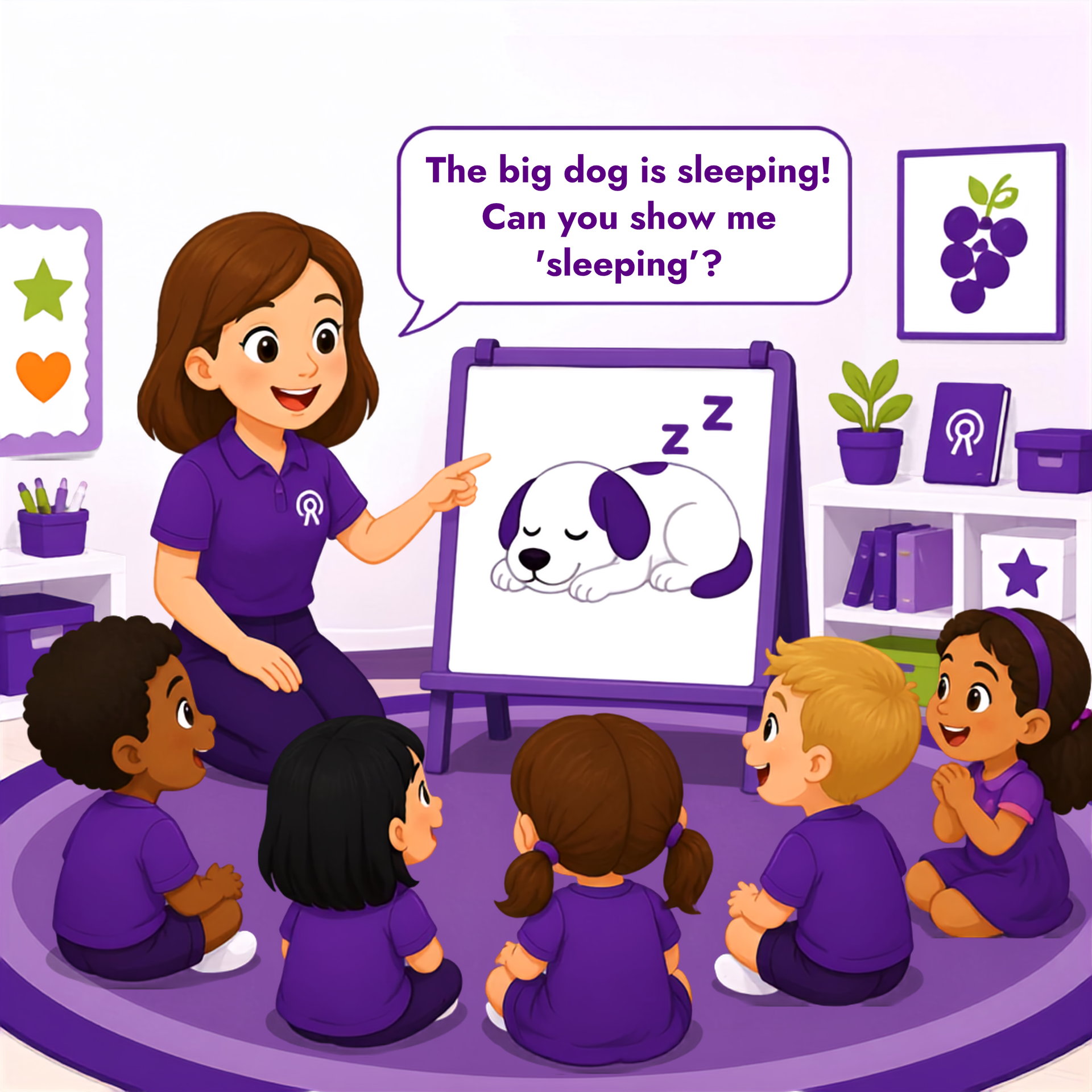
GrapeSEED gives young MLLs abundant opportunities to build oral language, vocabulary, listening comprehension, phonemic awareness, and communication skills through meaningful interaction. Songs, stories, action activities, shared reading, repeated readings, language expressions, phonogram cards, phonogram word cards and more… give children multiple opportunities to hear and use English in engaging, developmentally appropriate ways.
And that matters!
A child learning English needs more than a worksheet or a list of words. They need to hear it, say it, act it out, talk about it, and use it in context. Those rich language experiences help build the foundation upon which later literacy skills can grow.
A Positive Step Forward
The growing focus on the Science of Reading represents an exciting opportunity to make literacy instruction more intentional, research-informed, and accessible for all children.
For our youngest multilingual learners, that means keeping the big picture in view: build the language, build the knowledge, build the foundational skills—and make it meaningful and joyful along the way.
Because when children have a strong language foundation and evidence-based literacy instruction, everyone wins!
Ready to get started with GrapeSEED for YOUR students?