Moving and Learning…Why They Go Together!
Jodie Shell • September 30, 2020

As an Early-Childhood Educator for 20+ years, I have always had a handle on the developmental stages and capabilities of my very active little learners. Even so, if I had a nickel for every time I pleaded, “Honey, please sit still” or “Can you try to control your body?” or even “Sweetheart, tell your feet (or arms or hands or legs) ‘not now feet, I’m learning!’ ”, I would be one wealthy lady! While I have been keenly aware that this notion of being able to show a little bit of self-control was all part of a child’s natural development, what I  didn’t  know reaches far beyond that and is more scientific in nature than I realized.
According to an  article in the Washington Post , it seems that in 2015, school aged children throughout the world are very often walking around with an “underdeveloped vestibular (balance) system due to restricted movement.” Factors contributing to this phenomenon can range from too much screen time (computer, video games, movies and television) parents keeping children indoors for safety reasons, lack of scheduled recess or sports time, and more. The article explains, “In order to develop a strong balance system, children literally need to move their body in all directions, for hours at a time. Just like with exercising, they need to do this more than just once-a-week in order to reap the benefits. Therefore, having soccer practice once or twice a week is likely not enough movement for the child to develop a strong sensory system.”

According to Pediatric Occupational Therapist  Angela Hanscom , the implications are this, “Children are going to class with bodies that are less prepared to learn than ever before. With underdeveloped sensory systems not quite working right, they are asked to sit and pay attention. Children naturally start fidgeting in order to get the movement their body so desperately needs, but is not getting enough of, to ‘turn their brain on’.” Unfortunately, this fidgeting or moving around can sometimes be construed as misbehavior, which can lead to being sent out of the classroom, being made to apologize to the class, visiting the principal’s office and more.

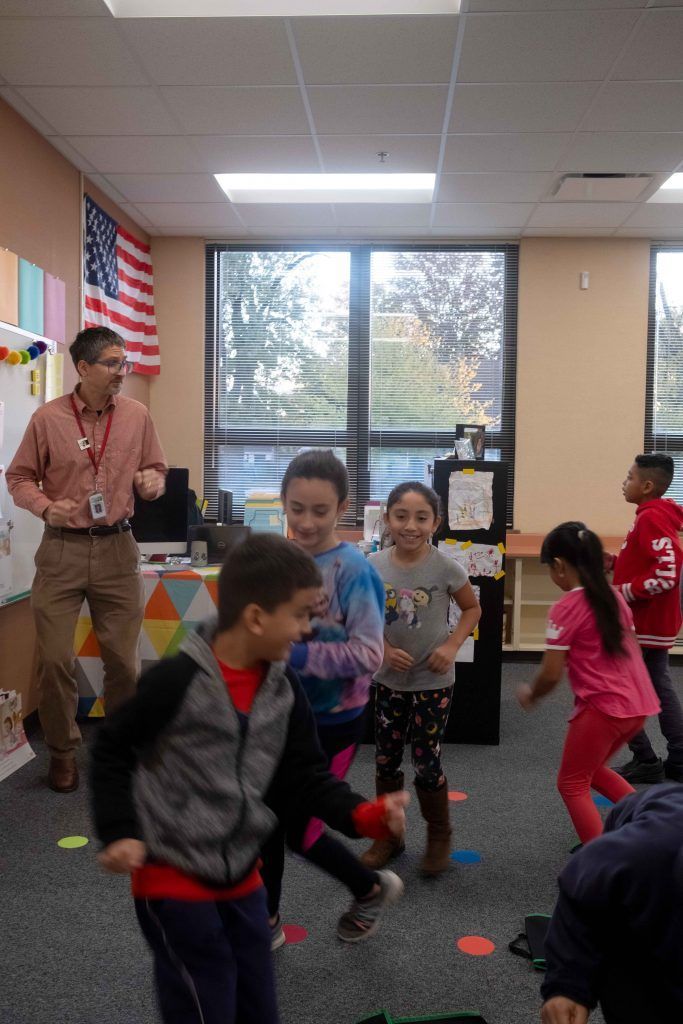
Thankfully, our GrapeSEED instruction provides for lots of action and movement, all within the context of learning! When children are invited to “hop like a rabbit”, “run like a zebra”, “move to the right/the left/up and down” and so forth, they are not only learning various actions, visualizing, demonstrating Total Physical Response and learning to respond to commands all while having fun… they’re also exercising and maturing their entire vestibular system, which will, in the end, allow for success in the classroom and beyond. And isn’t that the point?


December 2, 2025
In today’s classrooms, elementary school teachers juggle countless responsibilities—planning engaging lessons, managing behavior, communicating with families, and differentiating instruction for every learner. Fortunately, Artificial Intelligence (AI) is opening up a world of support tools that can help educators reclaim valuable time while still meeting the diverse needs of their students. Lesson Planning, Simplified AI tools and other educator-focused platforms can generate customized, standards-aligned lesson plans in minutes. Whether you're teaching reading comprehension, performing science experiments, or developing math centers, AI can help you brainstorm activities, create differentiated tasks, and suggest formative assessments—all tailored to your students’ grade level and learning goals. Behavior Intervention Plans Made Easier Creating thoughtful, individualized behavior intervention plans (BIPs) often requires collaboration and time that’s hard to find. With the right prompts, AI can assist by generating plan templates, suggesting positive reinforcement strategies, and even helping you write goal-specific language that’s clear and professional. This allows for quicker implementation and better support for student growth. Boosting Communication with Families Need to send home a weekly newsletter, a classroom update, or a quick note in family-friendly language? AI can help you write clear, respectful, and engaging messages in seconds—and even translate them into multiple languages. This promotes stronger school-home connections without adding to your workload. More Than Just Words AI isn’t just about writing. It can generate visual aids, adapt texts for different reading levels, offer creative ideas for classroom themes, or even draft rubrics and anchor charts. When used responsibly, AI becomes a teaching assistant in your pocket—offering fresh ideas and saving you time. A Word of Caution—and Empowerment AI isn’t a magic wand, and it doesn’t replace the care, creativity, and wisdom that teachers bring to the classroom. But when used thoughtfully, it can remove some of the mental load and help you focus on what matters most: building relationships, inspiring learners, and making a lasting impact. AI can be a game-changing tool for educators—not by replacing the human touch, but by enhancing it. With the right approach, you can use AI to create, communicate, and collaborate more efficiently—without sacrificing quality. Just as AI can support teachers in the classroom, GrapeSEED does the same. From intentionally designed lesson plans to materials at your fingertips, to a results driven, joy filled curriculum for your language learner students, GrapeSEED has it all. Click here to learn more !
November 3, 2025
If you’ve ever looked at your lesson plans and thought, “There’s no way I can fit all this in,” you’re not alone. Teachers today face an ever-growing list of standards, assessments, and initiatives, all while striving to create joyful, meaningful learning experiences for young children. The struggle is real! So how can we honor curriculum expectations without overwhelming ourselves or our students? Read on for ideas and strategies! Start with What Matters Most Not everything carries equal weight. Identify the skills and concepts your students truly need to succeed, both academically and developmentally. Prioritize depth over breadth when possible. A well-understood concept is more valuable than one that’s been rushed and checked off a list. Integrate Across Subject Areas Look for ways to blend content. A science lesson can include reading comprehension. A writing activity can connect to social studies. Integration allows for richer, more efficient learning and saves time while deepening student understanding. Protect Time for Play, Talk, and Joy Children learn best when they are engaged and emotionally connected to content. Carve out time for class discussions, movement, and creative exploration. These “non-academic” moments often bring about the deepest learning and are critical for social-emotional development. Be Realistic, Not Perfect It’s okay if not every lesson goes as planned or every objective is met on the first try. Focus on consistent growth, not perfection. Trust your professional judgment. After all, you know your students best. Support One Another Collaboration is key. Talk with teammates about what’s working, what can be scaled back, and how to share the load. A balanced curriculum starts with a balanced teacher, and that balance often comes from working together. Remember, you aren’t just covering content, you’re helping to shape children’s lives. When we prioritize purposeful, joyful learning over packing it all in, we give students (and ourselves) what truly matters most.. To learn how GrapeSEED English for Children saves teachers time so that they can focus on what is important, click here today!
October 6, 2025
What is inevitable in most schools across the United States? Standardized testing! And for our English Language Learner students, there is no getting around it... standardized tests are nonnegotiable. So, what is the challenge for elementary teachers and administrators? Striking the right balance. The key to that balance is preparing children for these assessments without completely tossing out developmentally appropriate instruction AND without creating anxiety. Why Preparation Matters While standardized tests might not capture the full range of our students' growth, they do influence school accountability, placement decisions, and even the allocation of funding and other resources. So, we prepare our students…not by ‘teaching to the test’, but by giving them the skills that they need to feel comfortable and confident during testing time. Multilingual learners, especially, benefit when we scaffold their testing experience, making sure they understand test formats, directions, and strategies, so they can truly show what they know. Ready for a few practical test prep ideas? Let’s dig in! Meaningful and Age-Appropriate Strategies 1. Build Familiarity Through Routine Incorporate test-like questions into regular classroom activities in a low-stakes way. Use short passages, multiple-choice questions, and timed activities that mimic test conditions, without the pressure. 2. Focus on Language and Concept Development ELL students need time to develop academic vocabulary and comprehension skills. Embed test-related language (e.g., “main idea,” “infer,” “evidence”) into their daily instruction in ways that make sense contextually. 3. Use Play and Movement For younger learners, active learning helps reinforce skills. Try review games, partner quizzes, or station rotations. These help students internalize content and practice test-taking skills in an engaging, age-appropriate format. 4. Practice Metacognition and Self-Talk Teach simple test-taking strategies like rereading the question, eliminating wrong answers, and checking work. Model “think alouds” to show how good test-takers reason through tricky questions. 5. Support Emotional Readiness Let students know that tests are just one way to show learning. Create a calm, encouraging classroom culture that frames testing as a chance to “show what you’ve learned,” not a judgment on their worth or ability. A Final Thought for Administration Administrators play a vital role in ensuring that multilingual learner teachers are supported with training, resources, and realistic expectations. Providing carved out time for your teachers to focus on standardized test readiness and making room for differentiated assessments, shows your support and commitment. When done thoughtfully, preparing your students for testing time can reinforce key skills, boost their confidence, and ensure that every student…especially our multilingual learners…have a fair chance to succeed. Are YOU looking for the best way to support your multilingual learner students? Then YOU’RE looking for GrapeSEED! Click here to learn more.
September 22, 2025
Are you a teacher of multilingual learners? If you’re answer is a resounding ‘YES’, then you have very likely heard the term ‘comprehensible input’ over and over again. But what does it actually mean and why does it matter so much? Comprehensible input is simply language that is just a teeny bit above a student’s level of understanding, but that can make sense and be understood with the scaffolds of context (like a story, for example), realia, props, gestures, facial expressions and so on. When your students receive this type of input during lessons, they are going to acquire language more naturally and effectively. You might be wondering, ‘why is this so important in my ESL classrooms?’ The answer is because language acquisition thrives on understanding. When students have a high level of anxiety because they’re overwhelmed with unfamiliar vocabulary and speech that is super-fast, they’re very likely to just ‘shut down.’ However, when we as teachers mindfully make our input very clear and add those scaffolds mentioned, children grow in confidence and are much more willing to engage and take academic risks. Try these easy yet effective strategies to build comprehensible input into your lessons: o Use props and realia: Using real life objects, props and pictures makes a big impact! Showing a picture of a tree while saying “This is a tree” makes meaning click instantly. o Slow your pace and use gestures: Use a moderate pace when speaking and be certain to pronounce words clearly. Use body language to support what you’re saying, when appropriate. Remember that a smile and a well-planned gesture can go a long way when building comprehensible input. o Repeat and rephrase: Saying things in a different way when is seems as though your point didn’t get across can be key. For example, if “Let’s line up” causes confusion or misunderstanding, try “Get in a line, please…one behind the other.” o Build on the ‘known’: Connect new learning to things that your students have already learned or experiences. This makes new information feel much more familiar and easier to grasp. o Check for understanding: Use short sentence frames and yes/no & either/or questions to check for understanding in a way that is low stress for your students. Remember, comprehensible input isn’t about “dumbing down” language—it’s about making it meaningful and accessible. When students understand what they’re hearing or reading, they’re more likely to respond, participate, and grow. And that’s when the real language magic begins! Does the GrapeSEED English for Children curriculum include comprehensible input? Yes, it definitely does, and in multiple ways! Learn all about it, along with how YOU can get started with GrapeSEED, by clicking here .
Show More